Support
OSHA’s Bloodborne Pathogens standard (29 CFR 1910.1030) requires employers to protect workers who are occupationally exposed to blood and other pot...
View full detailsFact SheetThousands of federal employees are injured, become ill, or are killed in work-related incidents each year. During FY 2004, approximately ...
View full detailsOSHA Requirements When a Worker Experiences a Job-Related Injury or IllnessOver the past three decades, occupational injuries and illnesses in the ...
View full detailsWorking Safely Near Overhead Power Lines Working with or near power lines can expose workers to electrical hazards, but these dangers can be avoid...
View full detailsRoof Tarping (Blue Roof) SafetyReinforced plastic tarps, commonly called “Blue Roofs,” provide temporary protection for the roofs of homes and othe...
View full detailsMotor Vehicle Safety FactsThe U.S. Department of Labor's Occupational Safety and Health Administration(OSHA) in partnership with the Department of ...
View full detailsMolds are the most common forms of fungi found on earth. They can grow on almost any material, as long as moisture and oxygen are available. Most m...
View full detailsElectric Power Generation, Transmission and Distribution: Minimum Approach Distance, Information Transfer and Training Requirements This fact sheet...
View full detailsProtecting Workers from Lead HazardsCleaning up after a flood requires hundreds of workers to renovate and repair, or tear down and dispose of, dam...
View full detailsLaboratory Safety OSHA Laboratory StandardOSHA’s Occupational Exposure to Hazardous Chemicals in Laboratories standard(29 CFR 1910.1450), referred ...
View full detailsUsing Portable Generators Safely Portable generators are internal combustion engines used to generate electricity.They are useful when temporary or...
View full detailsThe United States Department of Labor’s Occupational Safety and Health Administration (OSHA) has issued a directive rescinding the Interim Fall Pr...
View full detailsFungi Hazards and Flood CleanupFlood conditions contribute to the growth and transmission of many kinds of fungi, some of which can cause sickness....
View full detailsHazardous Waste Operations and Emergency Response OSHA’s standards for general industry and the construction industry on hazardous waste operations...
View full detailsTraining Requirements for the Revised Hazard Communication Standard OSHA revised its Hazard Communication Standard (HCS) to align with the United N...
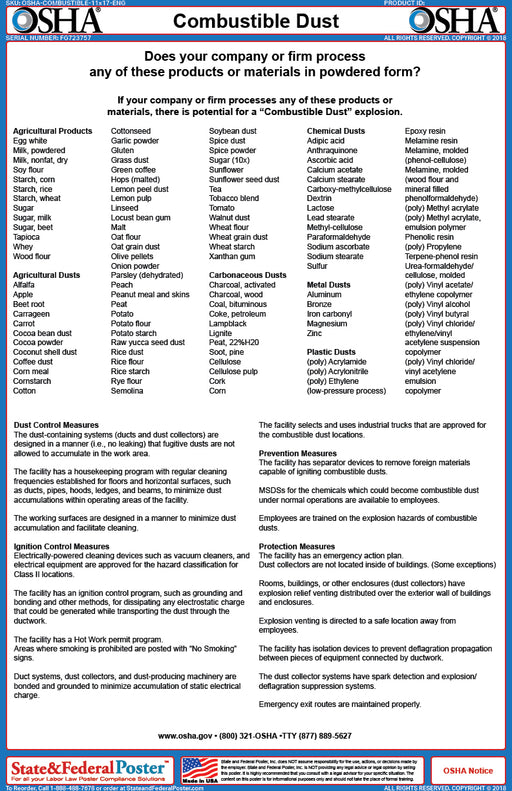
View full detailsIf your company or firm processes any of the products or materials on this list, there is potential for a “Combustible Dust” explosion. Dust Contro...
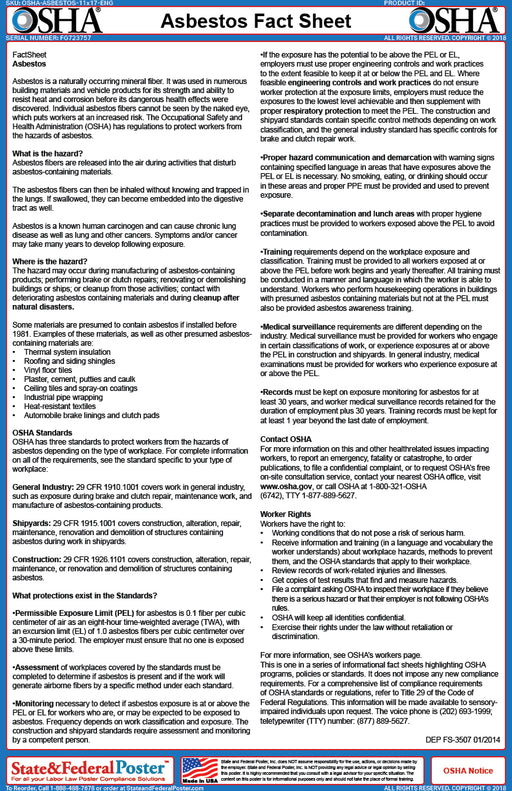
View full detailsAsbestos Asbestos is a naturally occurring mineral fiber. It was used in numerous building materials and vehicle products for its strength and abil...
View full detailsOSHA Workers Rights 3021-12R This poster presents a clear and impactful overview of the rights and protections provided to workers under the Occu...
View full detailsOSHA’s Whistleblower Protection Program enforces the provisions of more than 20 federal laws protecting employees from retaliation for, among other...
View full detailsWinter driving can be hazardous and scary, especially in northern regions that get a lot of snow and ice. Additional preparations can help make a ...
View full detailsHepatitis B virus (HBV) is a pathogenic microorganism that can cause potentially life-threatening disease in humans. HBV infection is transmitted ...
View full detailsOSHA Fact Sheet Individuals working for Nuclear Regulatory Commission contractors, subcontractors, and licensees and Department of Energy contracto...
View full detailsTree Trimming SafetyThousands of massive trees may have been uprooted by powerful winds from a hurricane taking power lines and transformers with t...
View full detailsThis fact sheet provides guidance on conducting workplace safety inspections for safety officers and other workers who are assigned responsibility ...
View full detailsWork Zone Traffic SafetyTransportation incidents and workers struck by vehicles or mobile equipment account for the highest number of fatal work in...
View full detailsUpdates to OSHA’s Recordkeeping Rule: Reporting Fatalities and Severe Injuries OSHA’s updated recordkeeping rule expands the list of severe injurie...
View full detailsPlanning and Responding to Workplace Emergencies Nobody expects an emergency or disaster. Yet emergencies and disasters can strike anyone, anytim...
View full detailsUsing Aerial Lifts The major causes of injuries and fatalities involving aerial lifts are falls, electrocutions, and collapses or tip-overs. Aeria...
View full detailsWorking Outdoors in Warm Climates Hot summer months pose special hazards for outdoor workers who must protect themselves against heat, sun exposure...
View full detailsThis OSHA fact sheet provides prevention tips for tree care hazard risk factors such as: Traffic control Drop zones Wood chippers Aerial lifts Pow...
View full detailsInspection of Suspension-Type Highway Trailers Prior to Loading and Unloading with Powered Industrial Trucks The purpose of this Technical Informat...
View full detailsSafety Practices Once Tractor Trailer Drivers Arrive at a Destination Safety is just as important once a truck reaches a destination as when it is ...
View full detailsOSHA Penalty Adjustments In November 2015, Congress enacted legislation requiring federal agencies to adjust their civil penalties to account for i...
View full detailsOSHA InspectionsThe Occupational Safety and Health Administration is committed to strong, fairand effective enforcement of safety and health requir...
View full detailsThe National Fire Protection Association defines “high-rise building” as a building greater than 75 feet (25 m) in height where the building height...
View full detailsFeatures Poster size 11” x 17” Poster is available in English and in Spanish Front and back sides are laminated Quality printing in full color Att...
View full detailsCombustible dusts are fine particles that present an explosion hazard when suspended in air in certain conditions. A dust explosion can be catastro...
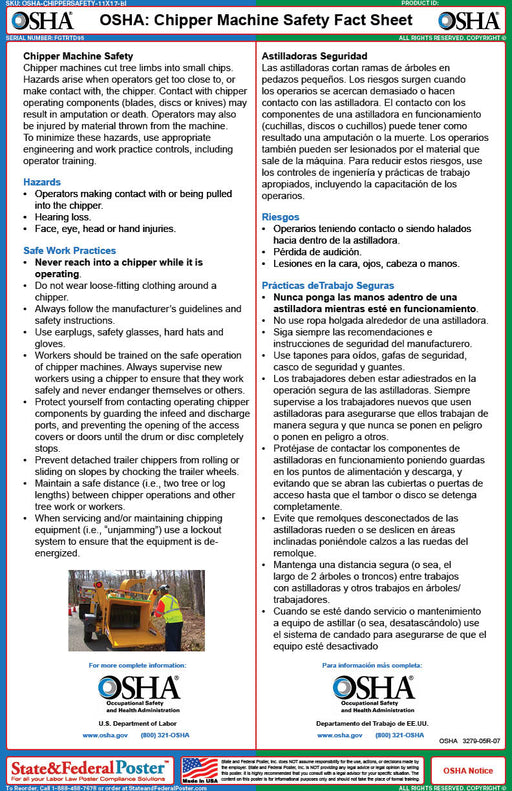
View full detailsChipper Machine Safety Chipper machines cut tree limbs into small chips. Hazards arise when operators get too close to, or make contact with, the c...
View full detailsHealth and Safety Recommendations for Workers Who Handle Human Remains Employers and workers face a variety of health hazards when handling, or wo...
View full detailsFire Ants Fire ants resemble ordinary ants. They average 1/8 to 1/4 inch in length and are reddish brown to black in color. Fire ants display aggre...
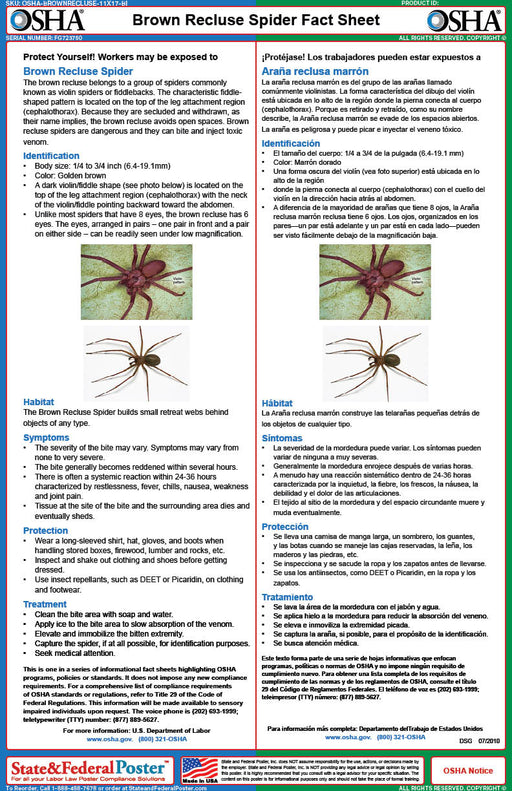
View full detailsBrown Recluse SpiderThe brown recluse belongs to a group of spiders commonly known as violin spiders or fiddlebacks. The characteristic fiddle-sha...
View full detailsFiling Whistleblower Complaints under the Moving Ahead for Progress in the 21st Century Act (MAP-21)Employees who work for motor vehicle manufactur...
View full detailsControlling Hazardous Fumes and Gases During WeldingWelding joins materials together by melting a metal work piece along with a filler metal to fo...
View full detailsGrounding Requirements for Portable GeneratorsPortable generators are internal combustion engines used to generate electricity.They are useful when...
View full detailsFireworks SafetyRetail Fireworks Sales Keep exits clear and accessible. Know all exit routes. Maintain view of fireworks. Know alarm procedures. K...
View full detailsCONTROL OF SILICA DUST IN CONSTRUCTIONHandheld Power Saws Used to Cut Fiber‑Cement BoardUsing a handheld circular saw to cut fiber-cement board can...
View full detailsDemolition and Cleanup Before starting a demolition, the person or persons in charge must adequatelyprepare for the task with regard to the health ...
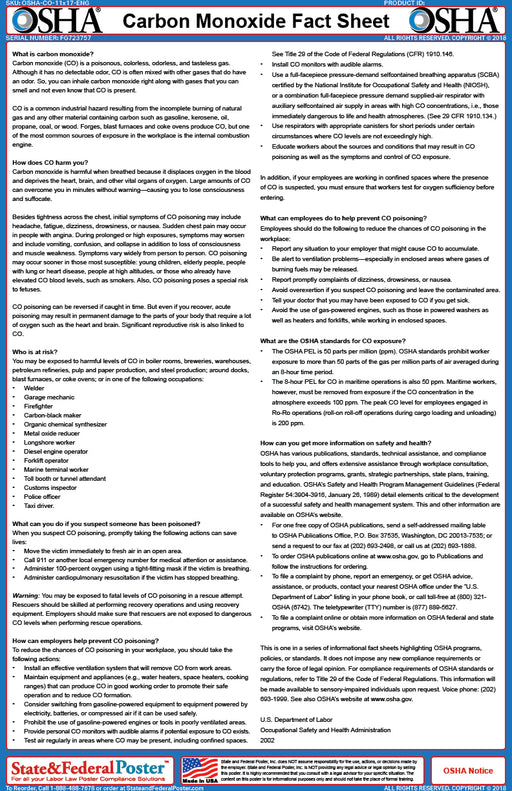
View full detailsWhat is carbon monoxide?Carbon monoxide (CO) is a poisonous, colorless, odorless, and tasteless gas. Although it has no detectable odor, CO is ofte...
View full details{"one"=>"Select 2 or 3 items to compare", "other"=>"{{ count }} of 3 items selected"}